
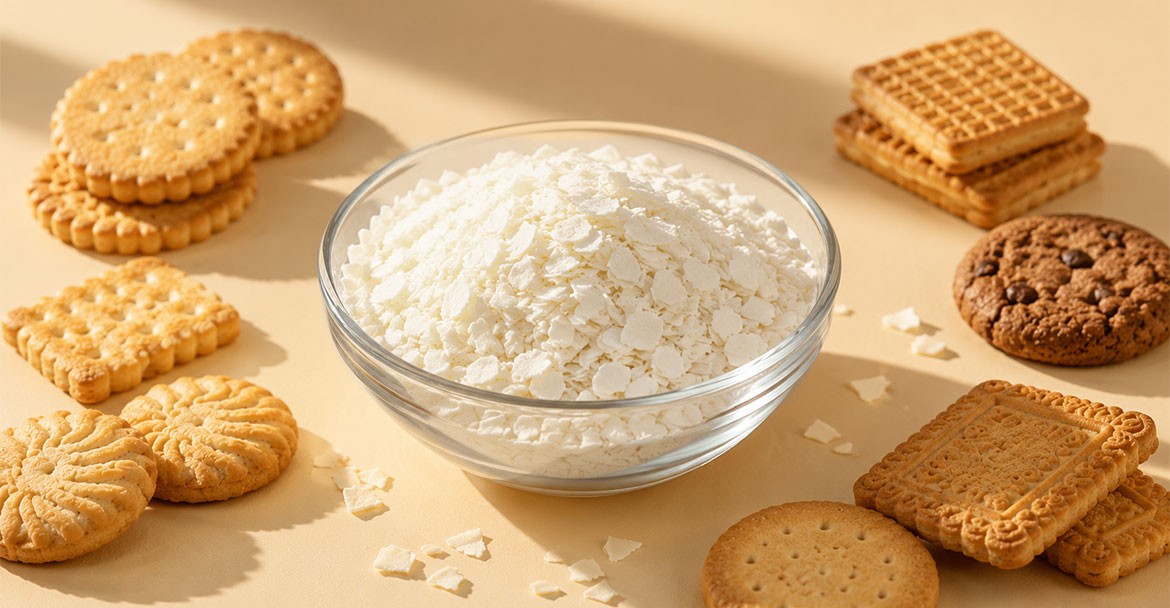
Biscuit manufacturing looks simple from the outside. Flour, fat, sugar, and a few minor ingredients come together, get baked, and turn into a familiar snack. In reality, the dough stage is where most quality problems begin. Fat does not always blend evenly with the other components, dough can turn sticky or too soft to handle on high speed lines, and the final bite often ends up dry or crumbly instead of short and tender. This is where distilled monoglycerides step in as one of the most dependable emulsifiers used across the biscuit and cookie industry.
What Are Distilled Monoglycerides
Distilled monoglycerides are a refined form of mono- and diglycerides, produced by esterifying glycerin with edible fatty acids and then purifying the mixture through molecular distillation. This distillation step removes the diglyceride and triglyceride fractions, leaving behind a concentrate that contains 90 percent or more monoglyceride content. Standard mono- and diglycerides, by comparison, usually contain somewhere between 40 and 60 percent monoglycerides.
That difference in purity is not just a technical detail. Monoglycerides carry the surface-active properties that make emulsification possible, so a higher concentration means stronger, more predictable performance in dough systems. Manufacturers looking for consistent results across batches tend to prefer distilled monoglycerides precisely because the emulsifying strength does not vary from one production run to the next.
Why Dough Consistency Depends on Fat Distribution
Biscuit dough is essentially an emulsion of fat, water, and dry ingredients. Fat and water do not mix on their own, and without help, fat tends to form uneven pockets within the dough rather than spreading through it uniformly. Uneven fat distribution shows up later as inconsistent texture, patchy browning, and biscuits that vary in thickness or shape across the same batch.
Distilled monoglycerides work at the interface between fat and water. Their molecular structure has a hydrophilic end that is attracted to water and a lipophilic end that binds to fat, allowing the two phases to combine smoothly. Once this happens, the dough becomes easier to sheet, cut, and handle on automated lines. Bakers dealing with sticky or unmanageable dough often trace the root cause back to poor fat dispersion, and adding a small percentage of distilled monoglycerides is usually enough to correct it.
The Role of Starch Complexation in Texture
Beyond emulsification, distilled monoglycerides interact directly with starch, and this is where their real value in biscuit texture becomes clear. During baking, starch granules absorb water and swell, releasing amylose molecules into the surrounding dough matrix. As the biscuit cools, these amylose chains begin to realign and recrystallize, a process known as starch retrogradation. Retrogradation is the main reason baked goods turn firm, dry, or stale over time.
Monoglycerides form a helical complex with amylose, effectively wrapping around the starch chains and slowing down their ability to recrystallize. This amylose-lipid complex is well documented in food science literature and explains why biscuits made with distilled monoglycerides stay softer for longer and resist the dry, chalky texture that develops as products age on the shelf. For manufacturers targeting extended shelf life without changing packaging or storage conditions, this starch-complexing property is often the deciding factor in choosing an emulsifier.
Better Aeration and Crumb Structure
Many biscuit formulations, particularly those made using the creaming method, depend on trapped air bubbles for their final structure. Fat needs to hold air efficiently during mixing so the biscuit rises properly and develops a light, even crumb rather than a dense one. Distilled monoglycerides support this by stabilizing the air-fat interface, allowing smaller and more evenly distributed air cells to form during creaming.
The practical outcome is a biscuit with a finer, more uniform crumb structure and a texture that feels short rather than tough. This matters especially in premium cookie and biscuit lines where mouthfeel is a key selling point, and where consumers can immediately notice the difference between a product that crumbles cleanly and one that feels dense or greasy.
Controlling Spread and Shape During Baking
Biscuit spread during baking is influenced heavily by how the fat behaves as it melts. If fat separates from the dough matrix too quickly in the oven, biscuits can spread unevenly or lose their intended shape. Distilled monoglycerides help stabilize the fat phase through the early stages of baking, giving manufacturers more predictable control over spread ratio and final dimensions.
This is particularly useful for high speed production lines where uniform size and shape directly affect packaging efficiency and product appearance on the shelf. A batch with inconsistent spread creates waste and rework, so tighter control at the dough stage translates into fewer downstream issues.
Typical Usage Levels
Distilled monoglycerides are generally used at low inclusion rates, commonly between 0.3 and 1 percent based on flour weight, depending on the specific biscuit formulation and the fat content already present in the recipe. Because the functional effect comes from the emulsifier's interaction at the fat-water and starch-lipid interfaces, only small quantities are needed to produce a noticeable improvement in dough handling and finished texture. Exact dosage still depends on formulation trials, since fat type, hydration levels, and processing conditions all influence the ideal inclusion rate.
Conclusion
Dough consistency and biscuit texture are not accidents of good luck on the production floor. They are the result of ingredients working together at a molecular level, and distilled monoglycerides play a quiet but essential role in that process. From smoothing out fat distribution to slowing starch retrogradation and supporting better aeration, this single ingredient touches almost every stage of biscuit quality. For manufacturers aiming for a softer bite, longer shelf life, and more predictable production runs, distilled monoglycerides remain one of the most reliable tools available in modern baking formulations.