
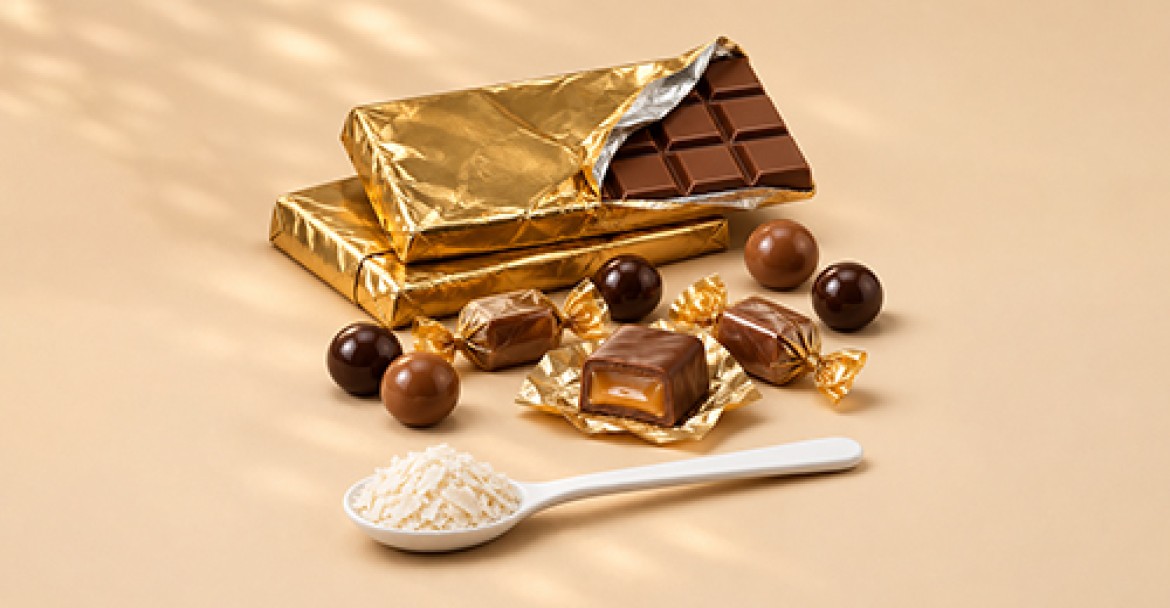
Sorbitan Tristearate is one of those quiet ingredients that decides whether a chocolate bar still looks right after six weeks on a shelf. The job is easy to state and hard to do: hold the fat in a bar the way the manufacturer set it.
Keeping the fat set is unusually hard with cocoa butter, which never fully settles. Long after a chocolate bar is moulded and wrapped, the fat crystals inside keep rearranging into a more settled pattern, and that slow change is what eventually shows on the surface as fat bloom. Slowing that rearrangement is what Sorbitan Tristearate is for, and its story starts with tempering.
Why Chocolate Loses Its Gloss
Tempering is the controlled heating and cooling that chocolate goes through before moulding, and the point of the exercise is to set cocoa butter into one particular crystal form, known as Form V. Those crystals lock together into a fine mesh that runs right through the bar and holds it firm at room temperature. A bar built that way has a clean shine, a sharp snap and a smooth melt, which is why no quality chocolate manufacturer skips this step.
Form V is stable, but not the most stable form cocoa butter can take. Left to itself, the fat keeps settling into a tighter arrangement still, and that is what turns a glossy bar dull, grey and dusty. The shift takes weeks to months on a shelf. Warm storage speeds the change along, and so does temperature cycling, where a warehouse heats through the day and cools overnight.
Filled chocolate products face a second pressure, and one that works faster than shelf ageing. A praline or a nut-centred chocolate carries a soft filling of ground nuts and sugar inside a moulded shell, and fillings like that are built on oils that stay liquid at room temperature. Liquid fat does not sit still next to solid fat. Oil from that nut centre slowly migrates into the shell, softening the fat phase and unsettling the crystals from the inside. Part of the cocoa butter network dissolves into the arriving oil and sets again in a coarser arrangement, which is the bloom itself. That is why the dull patch usually shows up over the centre first, while the rest of the shell still looks fine.
None of this makes the chocolate unsafe to eat. The damage is commercial, in rejected stock, returned consignments and customer complaints about a chocolate bar that looks stale, which is why keeping cocoa butter crystals from resetting matters.
Sorbitan Tristearate: The Ester That Stabilises the Fat Phase
Two things explain how one ingredient, Sorbitan Tristearate, slows a change happening inside solid fat: what the ester is made of, and what the ester does once the chocolate sets.
A Lipophilic Ester of Sorbitol and Stearic Acid
SOL Sorbitan Tristearate is produced by esterifying sorbitol with stearic acid. The material arrives as cream to yellowish flakes or powder and melts between 55 and 65°C. On a European label the same ester appears as E492.
Sorbitan Tristearate strongly prefers fat to water. On the HLB scale, which runs from about 0 to 20 and measures that preference, the ester scores 2.2, near the very bottom.
So rather than parking itself at a water boundary the way most emulsifiers do, this one dissolves into the fat itself, right among the cocoa butter crystals where bloom starts.
Slowing the Crystal Change Behind Bloom
As a batch of chocolate cools, cocoa butter crystals form and knit together into a mesh on their own.
The ester hardens into the same mesh rather than sitting loose in the gaps between crystals, much as steel is set into concrete rather than laid on top. What comes out is a stiffer structure than cocoa butter builds on its own.
That stiffness is what keeps a bar glossy for longer. Bloom begins when cocoa butter shifts out of Form V, the arrangement tempering built, into one that is more settled still. The shift happens while the chocolate is solid, so fat molecules have to shuffle past one another into a tighter pattern. A stiffer mesh leaves them less room to move, which is what slows the shift down.
Where the Effect Shows Most
A plain moulded bar gives the fat an easy job: set once, then stay put. The three cases below make that harder, either because the fat itself is different, because something is leaking into it, or because the temperature will not hold steady. Those are where the ester earns its keep.
The first is compound coating, the chocolate-style coating on biscuits, wafers and enrobed products. Harder vegetable fats stand in for cocoa butter there, known as CBS and CBR, short for cocoa butter substitute and cocoa butter replacer respectively, and both set firm without tempering. Keeping cocoa butter low in those fat blends is central to bloom control, and the ester supports that work.
The second is filled products, where oil seeping out of the centre is already softening the thin chocolate shell moulded around the filling, loosening the very crystal mesh the ester is there to hold firm.
The third is chocolate moving through warm distribution without a cold chain. Where storage temperature cannot be controlled, the protection has to be built into the chocolate recipe instead, through the fats chosen and what is added to keep the crystals steady.
Worth saying plainly: Sorbitan Tristearate delays bloom rather than preventing the defect outright. Correct tempering and steady storage still do most of the work of keeping bloom away, and an anti-bloom agent works alongside both rather than in place of them. Sorbitan Monostearate is used in the same role, and only a trial in the actual recipe will show which of the two works better.
That same crystal-control behaviour is useful well beyond chocolate.
Sorbitan Tristearate Beyond Chocolate
Wherever a fat phase needs to stay the way a manufacturer left it, this ester has a role. The applications look different on a shelf, but each one asks the same thing of the material.
Where This Material Adds Value
- Chocolate and confectionery: acts as an antiblooming agent, holding gloss and surface appearance through storage and distribution
- Margarine and spreads: works as an antisandiness agent. Sandiness is the gritty, grainy mouthfeel that develops when fat crystals in a spread grow coarse over shelf life, and the ester helps keep those crystals fine
- Edible oils: anticrystallisation behaviour keeps oil clear in cool storage. Oils carrying higher-melting fractions turn cloudy when those fractions begin to crystallise out at low temperatures, which looks like a fault to a shopper even though the oil is sound
- Edible oils: anticrystallisation behaviour keeps oil clear in cool storage. Oils carrying higher-melting fractions turn cloudy when those fractions begin to crystallise out at low temperatures, which looks like a fault to a shopper even though the oil is sound
The ester does not change from one application to the next. What changes is the fat system around it and the defect a manufacturer is trying to avoid, whether that is a dull bar, a sandy spread or a cloudy bottle of oil.
Wrapping Up
Fat bloom is a crystallisation problem rather than a sign of spoilage, which is why the answer lies in the fat phase rather than in packaging or preservatives.
Sorbitan Tristearate slows the crystal change behind the defect, and the same behaviour keeps margarine smooth and cooking oil clear. For manufacturers working with cocoa butter, compound coatings, or fat-based systems, the SPELL Organics grade is worth trialling.